
Wholesale Jewelry OEM Services Explained
Two letters decide who owns the design work: under OEM you arrive with the design and the factory produces it, under ODM you arrive with an idea and the factory develops it with you. Both routes sit on the same published spine — 3D CAD 48 hours, 25–30 days, 3–4 weeks — CAD, sample, run (run) — CAD, sample, run (run) — CAD, sample, run in production — and both are quoted against the same floors of 50, 100 and 100+ pieces per design.
Key takeaways
- OEM means you supply the design and keep the IP; ODM means the factory develops the concept into a collection for your brand.
- CAD comes back inside 48 hours, master sampling takes 25–30 days and mass production 3–4 weeks after approval.
- The service set is design-to-mass-production, engraving for logos and text, and custom packaging design.
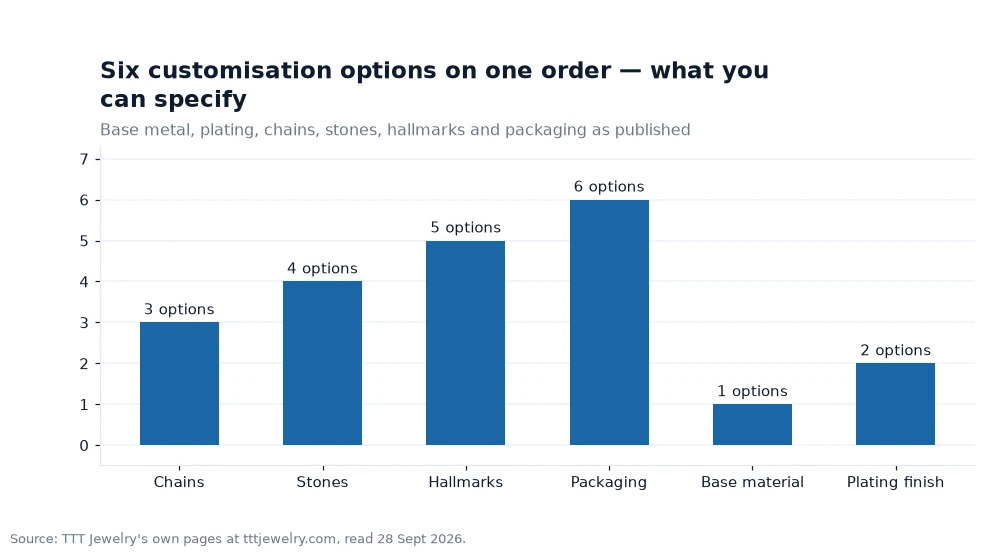
- Six customisation options are published: base material, plating, chains, stones, hallmarks and packaging.
What OEM actually hands over
In an OEM arrangement the buyer owns the design and the manufacturer owns the process. You send sketches, reference photos or a technical pack; the factory turns them into a dimensioned 3D CAD model and a rendering within 48 hours, then casts a master sample at 25–30 days. Every design file, mould and finished collection stays exclusive to your brand under a published 100% NDA.
That structure suits brands with a clear product point of view and an in-house designer, because the incoming brief decides the cost. The tighter the brief, the fewer sample rounds it needs.
Where ODM starts instead
ODM begins one step earlier, at the idea. The manufacturer takes a mood, a category or a price point and develops the concept through CAD and sampling into a co-created collection that is still exclusive to the buyer's brand. The difference in practice is who carries the development risk on a design that has never been made before.
Brands often start with ODM for a category they do not know well and move to OEM once they have their own CAD files. Neither route is a tier of service; they are two ways into the same workshop, and the published process converges at the prototype stage in both cases. Both are also quoted against the same MOQ floors, which is why a custom jewelry wholesale program can move a single design between the two models without renegotiating the terms around it.
The published flow from enquiry to carton
The full development route runs six stages: enquiry, consultation and development, CAD and prototype inside 48 hours, sample and approval across 25–30 days, bulk production once the sample is signed off, then final quality control and delivery with 100% inspection. The consultation stage is where feasibility, material selection and cost structure are settled, which is why it is worth arriving with a budget range rather than a single number.
Wholesale work is described even more simply as a five-step service flow: concept and design, master sampling, quality inspection, sample confirmation and mass production. Both descriptions point at the same gate — the customer's confirmation — and it is the reason a bulk custom jewelry for brands program should never be scheduled as if the sample were a formality. The page puts the intent plainly: "We are here to be your long-term production partner, not just another factory."
The six options a buyer actually specifies
Customisation is published as six fields, and they are the same fields quoted in both OEM and ODM work: material selection, stones and accents, chains and findings, plating and finishes, logo and hallmarks and the packaging set. Nothing else is decided at the design stage, which is what makes a brief comparable between suppliers.
| Option | Position in the published list | What it settles |
|---|---|---|
| Base material | 1st | 925 sterling silver, brass or stainless steel |
| Plating finish | 2nd | 14K, 18K, 24K gold or rhodium, multi-layer |
| Chains and findings | 3rd | How the piece hangs and closes |
| Stones and accents | 4th | Natural stones and freshwater pearls |
| Hallmarks | 5th | Laser-engraved a 316L mark on steel, S925 on silver and 18KGP for gold-plated pieces |
| Packaging | 6th | Tags, boxes, pouches, cards, barcode labels |
Three services that sit under the OEM umbrella
Beyond the options list, three specialised services are published: design to mass production, logo and text engraving, and bespoke packaging design. The first covers the whole path from drawing to delivery, the second uses high-precision laser engraving for logos and purity marks, and the third builds gift boxes, pouches and backing cards around the piece rather than around a catalogue code.
Those services explain why an OEM order is not just a production slot. A brand that cannot draw but can describe can still start; a brand with a finished design still gets help with the engraving and the box. The dividing line is where the design work stops, not what the factory is capable of.
Worked example: how many finishing combinations exist
Take the two options that multiply fastest. Three base materials — 925 sterling silver, brass and stainless steel — combine with four precious-metal finishes, 14K, 18K and 24K gold plus rhodium, giving 3 × 4 = 12 finishing combinations before a chain, a stone or a hallmark is chosen.
Then narrow it by the physical rules. Stainless steel is finished with PVD vacuum plating rather than a plating bath, while silver and brass take the gold or rhodium stacks and an additional anti-tarnish e-coating. That leaves 2 of 3 materials on the electroplating route and 1 of 3 on PVD — my own count of the published options, and the reason a 12-combination grid collapses to a much shorter shortlist once the base metal is fixed.
How the sample becomes the standard
The published position on consistency is worth reading before a repeat order is placed: the approved master sample is the benchmark for later runs, so the tenth batch is held against the same material source and the same surface standard as the first. For a brand selling through stockists, that sentence is the whole quality argument.
Ask how the reference is recorded. A sample held in a drawer at the factory is a weaker guarantee than a sample held by both sides with the inspection criteria written down, and the 100% inspection step before delivery is where those criteria get applied to an individual order.
Frequently asked questions
Do I need a designer to use OEM services?
No. Sketches, reference photos or a written concept are accepted inputs, and the CAD and rendering stage comes back inside 48 hours for you to approve the dimensions.
What is the difference between OEM and ODM in practice?
OEM produces a design you own, including your CAD files; ODM develops the concept with you and delivers a co-created collection that stays exclusive to your brand.
What are the minimum order quantities?
Fifty pieces per design in eco-brass, 316L stainless steel and 925 silver, counted per design rather than per purchase order.
Choosing the right entry point
Write down who owns the drawing before you write down the quantity, because that one answer decides whether you are buying production or development. The difference between the two contract models is worth reading in full, and if the piece has to survive water and daily wear, the stages that follow sample approval show where PVD finishing is added.
The figures used above — the three specialised services and the 50, 100 and 100+ piece order minimums, the six customisation points — are drawn from the maker's own site through tttjewelry.com, which I checked on 28 Sept 2026. Nothing else here is inferred. The unit conversions are my own construction[1].