
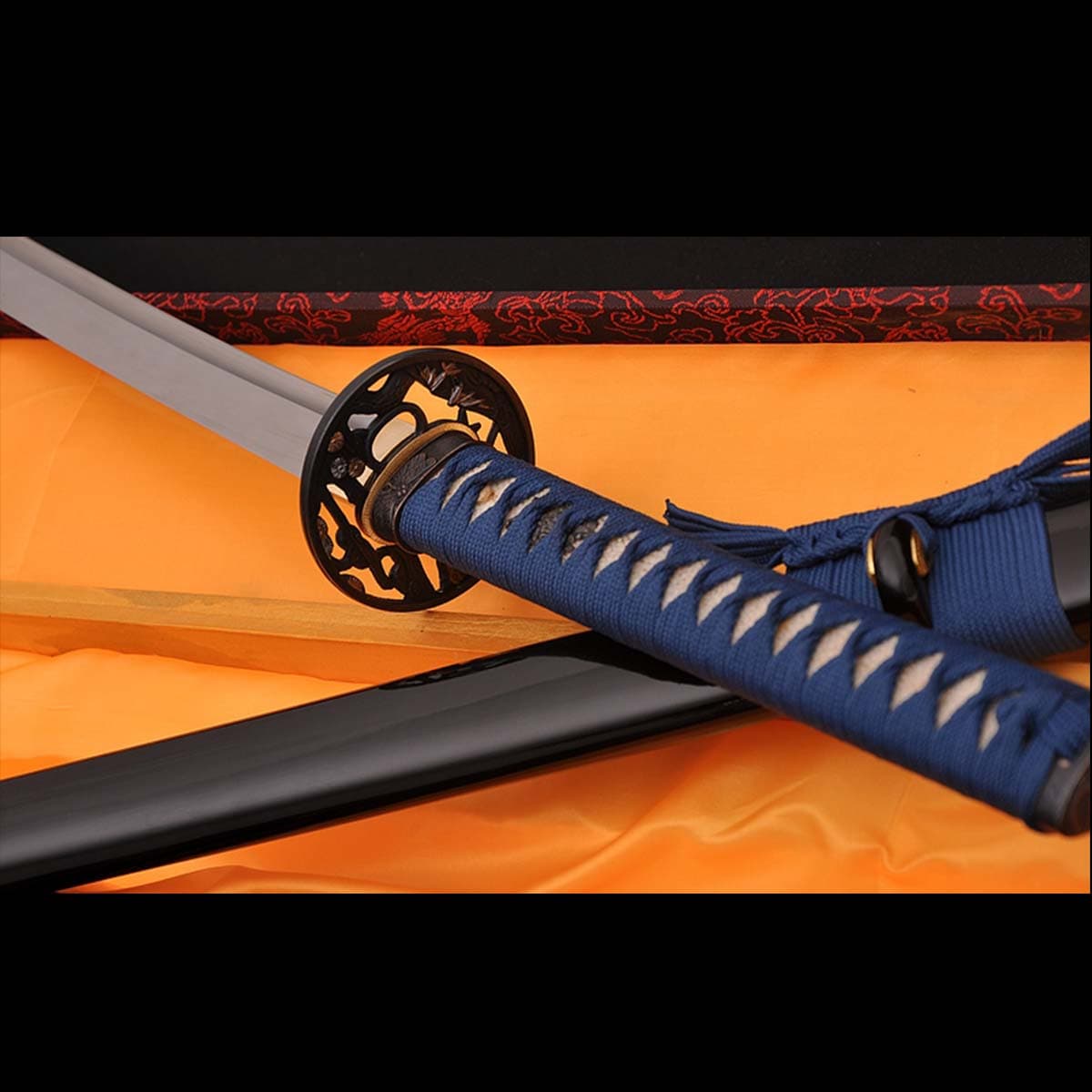
To verify an authentic real katana, analyze the steel structure through the microscopic orientation of carbon atoms. A genuine blade displays a distinct "hada" grain resulting from 12 folding cycles, producing approximately 4,096 distinct layers. Steel density in these traditional blades typically measures around 7.85 g/cm³, while commercial replicas often deviate by 5% due to inferior alloy mixtures. Documentation from the Nihon Bijutsu Token Hozon Kyokai (NBTHK) dating back to 1948 serves as the primary standard for verifying provenance and smith attribution.
The forging process begins with tamahagane, a bloomery steel produced in a tatara furnace over 72 hours of continuous heating. This raw material contains a specific carbon content ranging between 0.6% and 1.5%, which is carefully refined through manual folding to distribute impurities evenly.
Metallurgical analysis confirms that folding 12 times creates an exponential increase in layer count, effectively homogenizing the steel and reducing structural weak points found in mono-steel industrial blades.
Proper heat treatment requires a specialized clay coating process applied before quenching, which induces a localized cooling rate difference across the blade edge. The edge experiences rapid cooling to form martensite, while the spine cools slowly to retain a softer pearlite structure, enabling the blade to remain flexible while maintaining high edge hardness.
This differential hardening creates the hamon, which, under 10x magnification, reveals a crystalline microstructure known as nie or nioi. These structures are physical indicators of the specific temperature at which the blade was quenched, typically around 800 degrees Celsius for traditional Shinto-era swords.
| Feature | Authentic Blade | Industrial Replica |
| Hardness (HRC) | 58–60 (edge) | 45–52 (uniform) |
| Grain Pattern | Natural Hada | Artificial Acid Etch |
| Tang Surface | Natural Oxidation | Chemical Blackening |
The nakago, or tang, serves as the most reliable diagnostic tool for identifying a smith’s handiwork and historical period. Genuine tangs exhibit yasurime—file marks that follow specific geometric patterns characteristic of individual schools established between the 14th and 19th centuries.
Natural patina on an authentic tang develops over decades of contact with organic handle materials like rayskin and wood, resulting in a matte, dark brown oxidation that resists removal by light mechanical scrubbing.
Counterfeiters often attempt to simulate this patina using chemical accelerants or spray-on coatings which fail to penetrate the steel surface to the depth observed in century-old blades. Authentic swords possess a consistent, uniform aging profile across the entire exposed metal surface, unlike modern fakes that often show localized corrosion or uneven discoloration.
A critical physical examination involves measuring the sori (curvature) of the blade to ensure it matches the historical profile of the attributed school. Sword geometry is rarely linear; blades from the Kamakura period (1185–1333) often feature a deep curvature at the base, while later periods favored a shallower, more uniform arch.
| Era | Primary Curvature Point | Typical Sori (cm) |
| Kamakura | Near the base (Koshi-zori) | 2.5–3.0 |
| Nambokucho | Center (Chu-zori) | 2.0–2.5 |
| Edo | Near point (Saki-zori) | 1.5–2.0 |
When examining the koshirae (mountings), the fit of the habaki (collar) against the blade must be seamless. On a handmade sword, the habaki is custom-fitted to the specific geometry of the blade base, requiring a tight, friction-based attachment that shows no gaps under high-intensity lighting.
Disassembly of the handle reveals the presence of a single bamboo peg, or mekugi, which should fit snugly without movement. If the handle structure requires multiple screws or plastic bushings, the assembly does not follow traditional Japanese manufacturing standards.
Collectors should cross-reference any provided mei (signature) against the Tosho Zenshu database, which catalogs the recorded signatures of over 10,000 documented Japanese smiths. A signature that appears too deeply etched or inconsistent with the surrounding metal oxidation suggests a mechanical engraving performed long after the blade was completed.
Verify the sword’s geometry using high-precision digital calipers to confirm that the shinogi-ji (ridge line) remains perfectly aligned with the mune (spine) and ha (edge) through the entire length of the blade. Industrial mass-production lines often introduce minute structural asymmetries at the tip, known as the kissaki, which can be detected by measuring the width and thickness profiles at 10cm intervals along the length.
Professional authentication services utilize X-ray fluorescence (XRF) to analyze the chemical composition of the steel without damaging the item. Authentic blades from the 17th century often contain trace elements like titanium or phosphorus in specific ratios, whereas modern recycled steel displays a high concentration of vanadium or chromium due to recycled automotive or industrial scrap components.