
Premium fragrance does not simply take longer than value fragrance. It takes longer in specific places, and those places are knowable in advance. The launches that overrun are usually not unlucky; they are scheduled as if the premium tier differed only in price and materials. For a drugstore own-brand range, where the shelf reset is a fixed date and the buyer's credibility rests on hitting it, the mistakes below are the expensive ones.
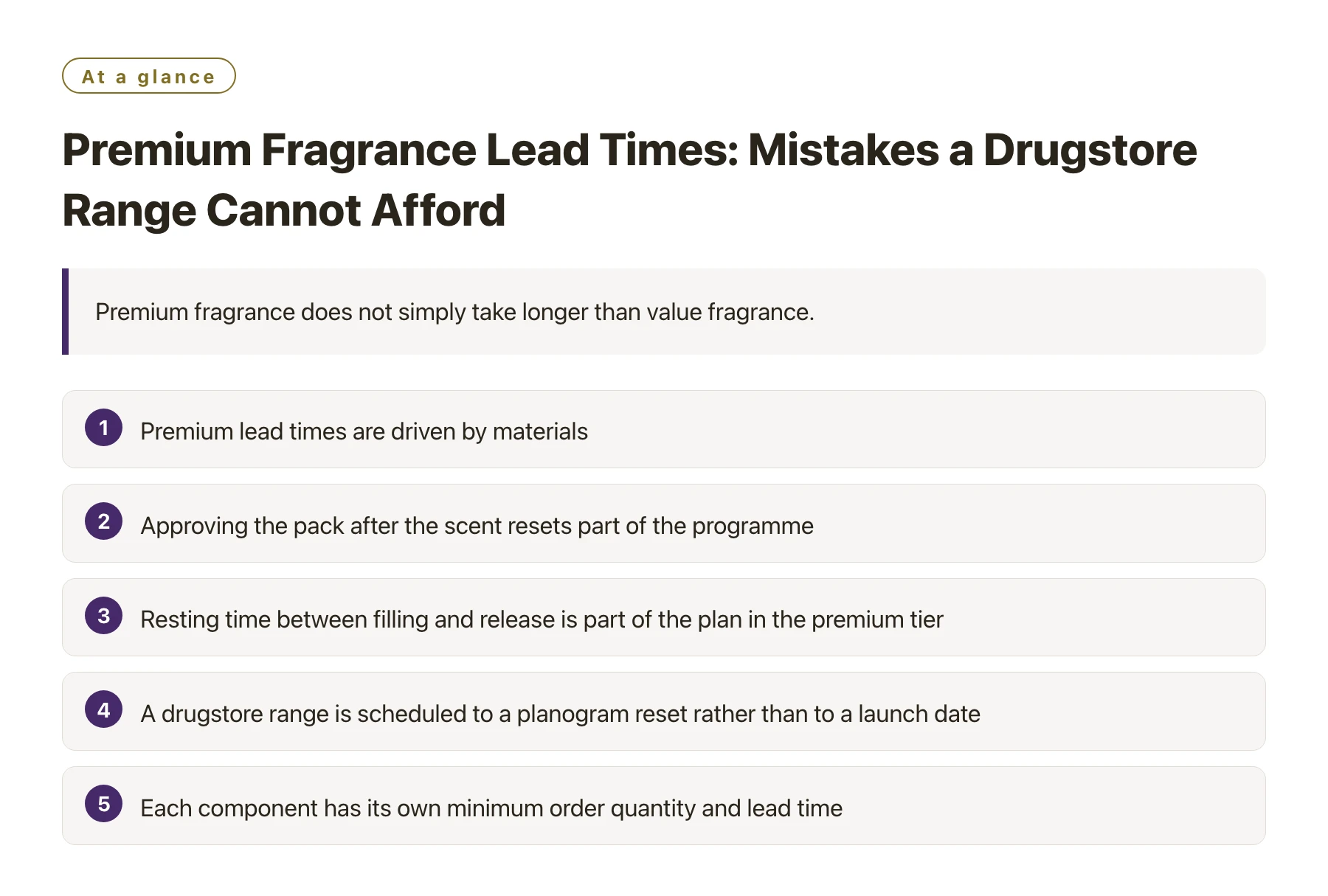
Key takeawaysPremium lead times are driven by materials, decoration and finishing rather than by the filling line, so the schedule should be built outward from the slowest component. · Approving the pack after the scent resets part of the programme, because decoration, filling and quality checks are sequenced around a confirmed bottle. · Resting time between filling and release is part of the plan in the premium tier, and treating it as optional is one of the most common sources of slippage [1]. · A drugstore range is scheduled to a planogram reset rather than to a launch date, which moves every deadline weeks earlier than the brand expects. · Each component has its own minimum order quantity and lead time, and the longest one sets the calendar regardless of how small the fragrance order is. · Quality release and documentation sit at the end of the schedule, and a range that leaves no room for them tends to ship late or ship with gaps in its file.
There is a version of premium fragrance planning in which everything is either expensive or fast. That version does not exist. Premium usually means materials with narrower supply, decoration steps that add handling, more hand finishing, tighter quality tolerances and a longer settling period before the product is considered ready. None of that is a secret, and all of it is routinely left out of a first schedule.
The reason is that the schedule is normally built backwards from the date the goods are wanted, using the filling lead time as the anchor. Filling is rarely the constraint. The constraint is upstream, in a component or a material that nobody asked about until the pack was designed.
Six scheduling mistakes that push a premium range late
The mistakes below are ordered by how early in the project they can be avoided. The first two cost weeks; the last two cost the launch date.
Starting from the bottle instead of the material
A premium brief often begins with a pack concept, because the pack is the visible part. The longer lead time usually sits with the fragrance materials, particularly where a specific quality or a signature material is involved. Building the schedule outward from the slowest material rather than inward from the bottle is a small change that removes an entire class of delay.
Approving the pack after the scent
Decoration, filling and inspection are sequenced around a confirmed bottle. If the pack is still being revised while the fragrance is approved, the production plan has to be rebuilt, and the rebuild usually happens during the busiest part of the calendar. Confirming the pack early costs a little design flexibility and buys a great deal of scheduling certainty.
Forgetting the settling period
Premium liquid is usually given time after filling before it is released, because the composition continues to change for a period after it is bottled. That period is real production time and belongs in the schedule. Brands that discover it late tend to either delay the launch or ship a product that does not yet smell like the approved reference [1].
Planning to the launch instead of the reset
A drugstore range does not go live on a launch date. It goes live when the shelf is reset, and the goods have to reach a distribution centre well before that. Working backwards from the reset, rather than from the marketing date, typically moves the production deadline several weeks earlier. It is the single most common misunderstanding between a retail buyer and a supplier.
Assuming every component has the same minimum
The fragrance may have a minimum order quantity that the brand can meet easily, while the custom cap, the pump or the printed carton each carry their own minimum and their own lead time. The longest of those sets the effective order size, and a range that is planned around the fill volume alone will be revised at the point when nothing can be revised cheaply.
Leaving quality release and paperwork to the end
Batch documentation, certificates and label checks are produced at the end of the schedule, but they depend on decisions made at the beginning. A range that does not reserve time for them either ships late or ships with an incomplete file, and an incomplete file tends to surface at the retailer's distribution centre rather than at the factory gate.
What a defensible premium schedule contains
A schedule worth circulating to a retail buyer shows six things: material confirmation, pack approval, first production slot, settling period, quality release, and dispatch. Each should carry a date and a named owner, and each should be expressed as a range rather than a single day where uncertainty is genuine. A schedule that shows only a start and a delivery date is not a schedule; it is an intention.
It should also show the decision points that could move everything, because those are the ones a buyer needs to be able to see. If pack approval slips by a week, does dispatch move by a week or by three? A supplier that can answer that question has a real plan. One that cannot is working from the same optimism as the brand.
It is worth agreeing at the start how slippage will be communicated, and how often the schedule will be refreshed. Weekly updates sound excessive until the first slip, at which point they become the cheapest early warning available. A range that communicates in real time can often be protected by moving a pack decision or a channel launch rather than by moving the reset.
Where a premium partner changes the picture
A manufacturer that works in the premium tier routinely has supplier relationships, decoration partners and quality processes built around the delays described above. That does not make the lead times shorter. It makes them visible earlier, which is the practical difference between a range that lands on time and a range that is discovered to be late.
Two questions are worth asking before committing. First, which stage is the binding constraint in the current calendar, and how far ahead is it booked. Second, what happens to the schedule when a decorative step has to be repeated, since rework is the risk that premium launches underestimate most often.
A premium fragrance production partner premium fragrance production partner should be able to answer both with specifics rather than reassurance, and should be willing to put the answer in writing. Quality control in luxury fragrance production quality control in luxury fragrance production is a large part of that answer, because the stages that catch drift are also the stages that consume calendar days.
It also helps to understand how capacity is really allocated. Production capacity and lead times production capacity and lead times are not fixed quantities; they are bookings in a plan that fills up ahead of seasonal peaks. A brand that asks about the booking position before confirming the pack is asking the question that actually protects the reset date.
The cheapest scheduling decision in a premium range is to confirm the pack earlier than feels comfortable. It removes rework from the critical path and costs nothing except a little design freedom.
Sources
- Cosmetics Business —— A trade publication covering the beauty and cosmetics industry, including fragrance launches and regulatory developments.
Frequently asked questions
How much longer does premium fragrance production take than value fragrance?
It varies too much to give a single figure. The difference comes from specific stages: narrower material supply, extra decoration handling, more hand finishing, tighter inspection and a settling period after filling. The right answer for a project is to identify which of those applies and size each one.
Does a settling period apply to every premium product?
It applies where the composition continues to change after filling and where the brand expects the shipped product to match the approved reference. The length depends on the formula and the pack, and it is worth confirming at the sampling stage rather than during production.
Why is a drugstore reset date harder to plan for than a launch date?
Because the goods must be at a distribution centre before the reset, not at the store on the day. Working backwards from the reset often puts the production deadline several weeks earlier than the marketing calendar suggests.
Can paying more speed up a premium range?
Sometimes, for specific stages such as air freight or an expedited decoration run. It rarely compresses material lead times or the settling period itself. It is more reliable to plan the calendar correctly than to buy back time at the end.
What should a schedule include to be taken seriously?
Named owners, dates with ranges where uncertainty is real, the binding constraint identified, and a statement of what happens to the delivery date if a specific decision slips. Those four elements turn a timeline into a plan.